
Criminal Cases in the Childress County Courts
Criminal court jurisdiction in Childress County depends on the charge. The 100th Judicial District Court hears felony cases. The constitutional Childress County Court ordinarily handles Class A and Class B misdemeanors. Fine-only matters can remain with the Childress Justice Court or Childress Municipal Court, based on where and how the case began.
The combined County/District Clerk is the practical records counter for district and county criminal case files. That shared office does not merge every docket in Childress County. Municipal and justice court records stay with those courts. An incident report also stays with the agency that made it, even after a prosecutor files a case. This split explains why a single name check may miss a valid court record.
Childress Criminal Case Court Map
Start with the alleged offense level, not merely the place of arrest. Texas law allocates cases among separate courts, and each office controls its own Childress County court records. The following local map identifies the most likely custodian.
| Court | Criminal role | Contact |
|---|---|---|
| 100th District Court | Felonies | 100 Avenue E NW, Suite 3; 940-937-7070 |
| Childress County Court | Ordinarily Class A and B misdemeanors | 100 Avenue E NW; 940-937-2221 |
| Childress Justice Court | Fine-only cases in JP jurisdiction | Courthouse first floor; 940-937-6145 |
| Childress Municipal Court | City ordinance and fine-only cases | 315 Commerce Street; 940-937-6943 |
A felony search belongs with the district file even if police made the arrest inside the city. A failure-to-appear matter tied to a city citation may remain at Municipal Court and never appear in a district query.
The combined clerk works on the courthouse second floor. Published counter hours are 8:00 a.m. to 4:30 p.m. Monday through Thursday, with a lunch closure, and Friday service ends at 3:30 p.m. The clerk can be reached at 940-937-6143. Since Friday hours differ across courthouse floors, confirm the correct office before making a Childress County case-record trip.
How to Search Case Records
The strongest Childress County criminal case search begins with the responsible local court. Online tools are supplements because neither the official LGS link nor re:SearchTX establishes a complete county criminal index.
- Identify the likely court from the charge level. Use district for felonies, county for most Class A or B cases, and municipal or justice court for the relevant fine-only case.
- Call or visit the combined County/District Clerk for district and county files. Give the name, approximate arrest or filing date, and any known cause number.
- Ask the municipal clerk or justice court directly about their own dockets. A county or district search does not cover every Childress County case.
- Check re:SearchTX for an electronically filed record from a participating clerk. Treat an online miss as inconclusive.
- Ask the holding clerk about plain copies, certified copies, older files, and document access. Local copy and certification charges were not published, so confirm the cost before ordering.
The identified statewide interface exposes access controls rather than a verified Childress criminal search form. These are the documented fields and routes that can safely be described.
| Field or control | Type | Required | Notes |
|---|---|---|---|
| Registration or login | Account access | Depends on record | Access and coverage vary by participating court |
| Participating court record | Electronic filing | Yes for a result | Not a complete statewide criminal index |
| Document retrieval | Paid download | Only for documents opened | $0.10 per page with a $1 minimum per document |
The official re:SearchTX screen shows the statewide participating-court entry point.
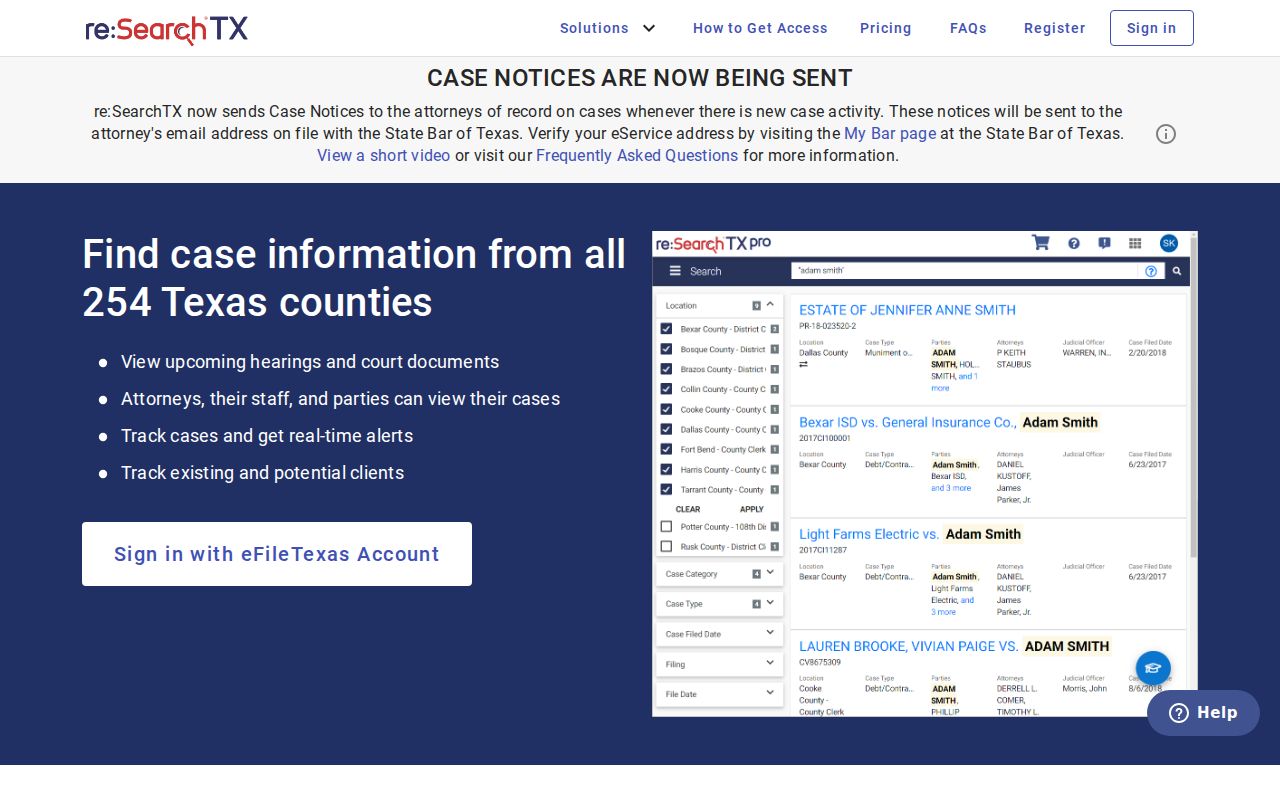
Its statewide reach is useful, but the clerk remains the authority on Childress County coverage, certification, and paper records.
Childress Case Records and LGS
The clerk's official page links to LGS Online Records and says county records are online. Yet the captured LGS landing page does not prove that its Childress collection contains criminal causes or case documents. Its broad index warnings discuss spelling variations, backup images, authenticity, and property redaction. Those points support careful index use, not a claim of complete criminal coverage.
Review the LGS Online Records landing page before relying on its search scope.
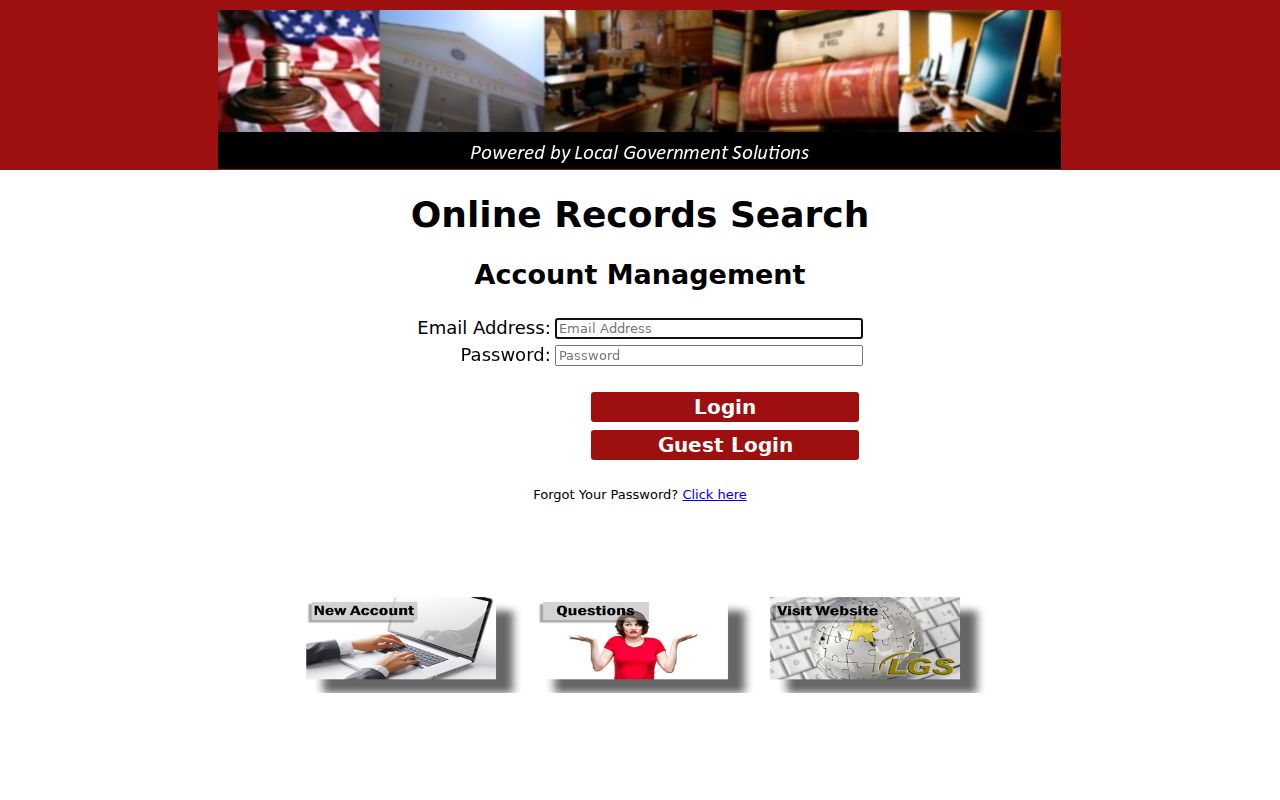
The safe route is to ask the combined clerk whether the desired criminal case type and date range are indexed, then request the file from the clerk if they are not.
Note: An LGS name-search miss does not show that no Childress County criminal case or older paper file exists.
What the Case File Shows
A Childress County court case file records the prosecution, not just the arrest. No official public Childress sample was available for inspection, so the entries below are expected clerk-held fields that should be confirmed for the specific cause. Document availability and redaction may differ by case.
| Cause number and court | The file identifier and the court that owns the docket. |
|---|---|
| Filed date and parties | When the case entered the court and the named parties and attorneys. |
| Charging document | A complaint, misdemeanor information, or returned felony indictment, as applicable. |
| Charge details | The alleged offense, statute, and classification recorded by the court. |
| Docket and settings | Hearings, filings, motions, orders, and scheduled court events. |
| Disposition and judgment | The outcome, such as dismissal, acquittal, deferred adjudication, or conviction. |
| Sentence and costs | Any sentence, community supervision terms, fines, costs, and related entries. |
| Document images | Pleadings or orders when the clerk or approved system makes them available. |
A DPS criminal-history response is different. It summarizes reported events. The court file carries the actual pleadings, orders, docket, judgment, and sentence for one prosecution.
Read Childress Criminal Case Outcomes
Outcome terms can look similar while carrying very different meanings. Read the disposition for each charge, since one Childress County case can contain more than one count and each count may end in a different way.
- Dismissal
- The charge ends without a conviction. It does not erase the earlier arrest by itself.
- Acquittal
- A not-guilty outcome after the court process.
- No-bill
- The grand jury declines to return a felony indictment.
- Deferred adjudication
- The court withholds a judgment of guilt during community supervision. Texas public DPS law may still show it unless nondisclosure applies.
- Conviction
- A judgment of guilt after a plea or trial.
For a final answer, obtain the judgment or dismissal order from the responsible clerk. A docket status alone may be current rather than final.
Stages of a Criminal Case
After law enforcement acts, the prosecutor and court create a separate record trail. Texas Article 15.17 calls for magistration without unnecessary delay, generally within 48 hours. A complaint can support the early process. Eligible misdemeanors may proceed by information, while a felony can move through a grand jury indictment.
Case flow: Charges Filed → Arraignment → Pretrial → Plea or Trial → Disposition → Sentencing
Discovery and motions can add many docket entries before the plea or trial. The judgment states the result, and a sentence follows an adjudication when applicable. Appeal activity may then add a new layer without replacing the trial-court file.
When Childress Case Records Are Missing
An online miss may reflect an older paper file, a spelling variant, delayed filing, limited portal participation, or a record that is sealed, expunged, or otherwise restricted. It is not proof that the event never reached a Childress County court.
Call the correct clerk and provide a narrow date range, the full name used in the case, and a cause or citation number if known. Ask whether the index covers that court and year. For a city citation, contact Childress Municipal Court. For a JP matter, use the justice court. If the question began with an arrest rather than a filed charge, the separate Childress County arrest history channels can identify the originating agency and custody record.
If the clerk locates the cause, ask which docket entries and document images are available, whether the file is paper or electronic, and what a plain or certified copy will cost. Childress County has not published those local criminal-copy charges. The re:SearchTX download rate is not a substitute for the clerk's certification fee.
Access & Restrictions
The Texas Public Information Act gives broad access to public information subject to exceptions, but filed criminal case records are requested from the court's clerk. They are not simply sheriff records. Constitutional and common-law openness, statutes, redaction rules, expunction, nondisclosure, and court orders can all affect what the clerk releases.
Juvenile records, victim-identifying information, Social Security and financial data, protected active-investigation material, sealed or nondisclosed files, and expunged records may be withheld or redacted. These outcomes are not the same. Expunction directs qualifying arrest records to be removed, destroyed, or returned under Chapter 55A. Nondisclosure limits general public access but preserves access for specified agencies.
Childress State and Federal Cases
Childress County state cases and federal cases use separate systems. The 100th District Court is the local felony trial court. A federal prosecution from Childress County belongs to the Amarillo Division of the U.S. District Court for the Northern District of Texas, not the county clerk's docket.
PACER provides federal party, docket, and document access after registration. Its charge is $0.10 per page, usually capped at $3 per document, while judicial opinions are free and quarterly charges of $30 or less are waived. PACER does not contain state 100th District cases. Conversely, the county clerk does not serve as the federal clerk. Choose the system from the prosecuting court named on the record.